
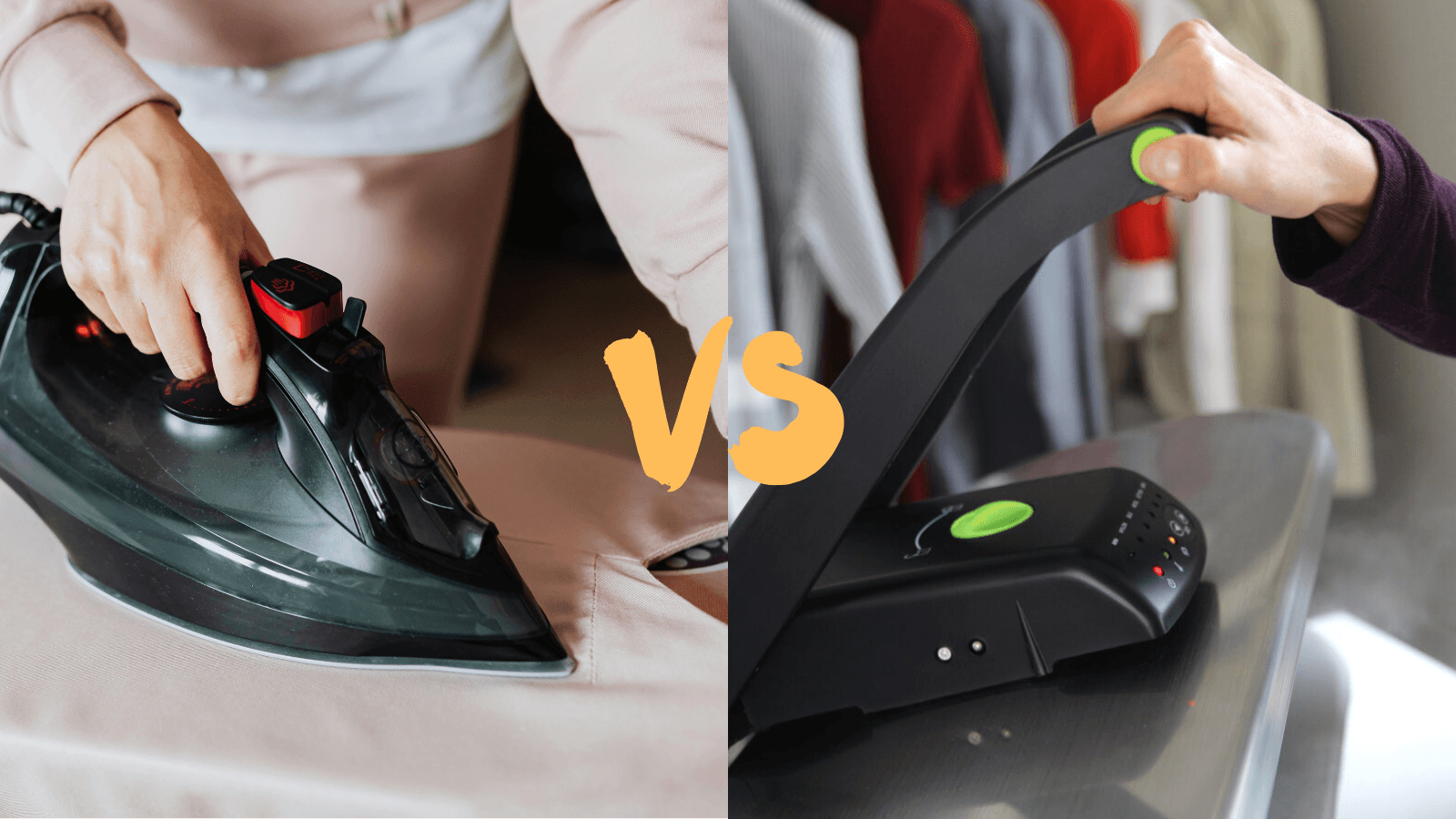
If you regularly find yourself facing mountains of wrinkled laundry, you’ve probably wondered whether there’s a faster way to get through it all. While most people are familiar with steam irons, steam presses remain relatively unknown despite being around for decades. The question is whether a steam press actually makes large loads easier or if it’s just another bulky appliance that promises more than it delivers.
Understanding how each tool works and what they’re truly good at can help you decide which one makes sense when you’re dealing with substantial amounts of ironing on a regular basis.
How Each Tool Works
A steam iron is handheld and requires an ironing board. You move the iron across fabric, applying heat, steam, and pressure to remove wrinkles. The process involves lifting the iron, repositioning it, setting it down, and repeating this motion continuously. You control everything manually (the pressure, the movement, the timing).
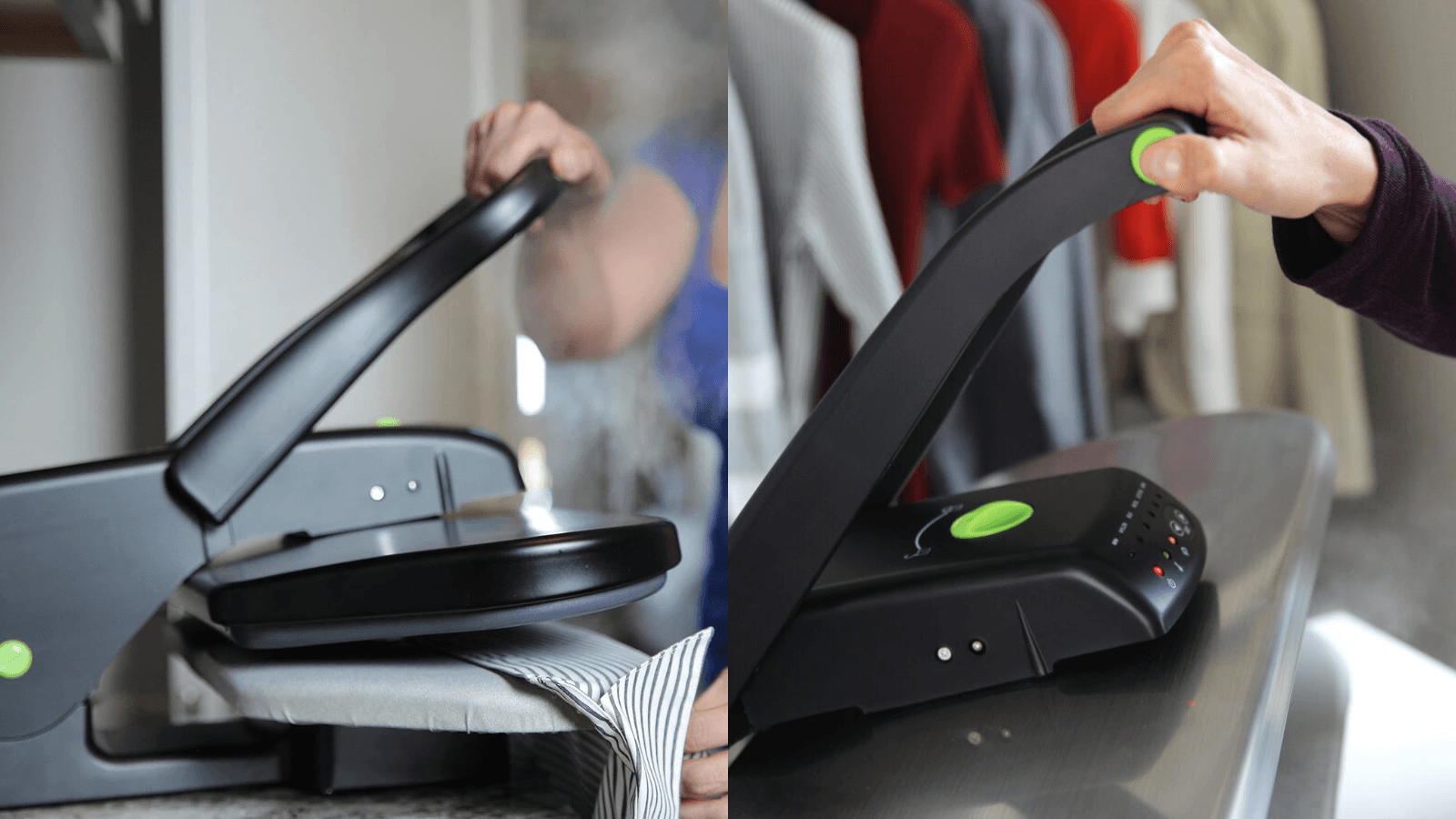
A steam press works more like a large clamshell that opens and closes. The bottom plate remains stationary while you position fabric on it, then you lower the top heated plate down onto the fabric. Some models use a hand lever to apply pressure, while others operate with a foot pedal or automatic pressure systems. Steam releases when the plates come together, and the large heated surface area presses a significant section of fabric at once.
This fundamental difference in operation creates distinct advantages and limitations for each tool.
Speed and Efficiency on Large Loads
Steam presses cover more surface area in a single press. Most home steam press models have pressing surfaces ranging from 24 to 30 inches wide and 10 to 12 inches deep. This means you can press an entire shirt front, a full pant leg, or a substantial section of a tablecloth in one motion.
With the best steam irons, you’re working with a soleplate that’s typically 5 to 7 inches long and 3 to 4 inches wide. You need multiple passes to cover the same area that a steam press handles in one go. For large flat items like sheets, tablecloths, curtain panels, or duvet covers, this difference becomes dramatic.
Time studies show that experienced users can press sheets and pillowcases approximately three to four times faster with a steam press than with an iron. A queen-size flat sheet might take 2 to 3 minutes with a press versus 8 to 12 minutes with an iron. When you’re doing multiple sets of bedding, those minutes add up quickly.
For garments, the speed advantage depends on the item. Simple rectangular pieces like pillowcases, cloth napkins, or flat fabric panels definitely go faster with a press. Fitted items like shirts and pants show less dramatic time savings because they require careful positioning regardless of which tool you use.
What Steam Presses Handle Best
Steam presses excel with flat, rectangular items. Bed sheets, both flat and fitted, become much easier to manage. Pillowcases take seconds per piece. Tablecloths and placemats, which can be tedious with an iron, press quickly and evenly. Cloth napkins for anyone who uses them regularly become almost effortless.
Curtain panels and drapes benefit enormously from steam presses. The wide pressing surface handles the fabric width efficiently, and you can work through long panels systematically without the arm fatigue that comes from ironing large curtains.
Kitchen towels, tea towels, and other flat linens press faster with minimal effort. If you’re someone who likes crisp, pressed kitchen linens, a steam press makes this practical rather than a time-consuming chore.
Large fabric pieces for quilting, sewing, or crafts press more evenly and quickly. The consistent pressure across a large surface area gives you better results than trying to iron large fabric sections.
Jeans and casual pants work reasonably well on steam presses. You can press each leg flat in one or two presses rather than working your way down with multiple iron passes.
Where Steam Presses Struggle
Anything with complex shapes or construction becomes awkward on a steam press. Dress shirts with yokes, darts, and curved seams require careful positioning and multiple presses for different sections. While it’s possible to press shirts with a steam press, many users find it slower and more frustrating than using an iron.
Garments with buttons, zippers, or embellishments need special attention. You must position these elements carefully to avoid crushing buttons or damaging decorative details with the press’s flat pressure. An iron lets you work around these features more precisely.
Small items and detail work suit irons better. Collars, cuffs, pocket flaps, and other small garment sections are easier to manipulate with a handheld iron than by positioning them carefully on a press surface.
Delicate fabrics can be tricky on steam presses. The large heated plate applying pressure across a wide area gives you less control than an iron, where you can adjust pressure and movement constantly. Silk, chiffon, and other fragile materials often need the gentler, more controlled approach that irons provide.
Three-dimensional items like jackets, structured dresses, or anything with padding and shaping are nearly impossible to press properly with a steam press. These need the maneuverability that only a handheld iron provides.
Physical Effort and Comfort
This is where experiences vary significantly between users. Steam presses eliminate the repetitive arm motion of ironing. You’re not constantly lifting and moving a weighted iron. For people with shoulder, elbow, or wrist issues, this reduction in repetitive motion can make a meaningful difference.
However, steam presses require different physical actions. You need to position fabric carefully, then either pull down a lever or push a foot pedal to apply pressure. Some models require significant force to operate the lever, which can be tiring for users with limited hand or arm strength. The standing position and the bending required to position fabric on the press surface can bother people with back problems.
Steam irons demand sustained arm and shoulder work but allow you to adjust your posture and position more freely. You can shift your weight, change angles, and move around your ironing board. The repetitive lifting gets tiring, especially over long sessions, but you have more flexibility in how you stand and move.
Neither option is universally easier. The better choice depends on your specific physical capabilities and limitations.
Learning Curve
Steam irons have a learning curve, but most people already know the basics from previous experience. Getting good at ironing involves developing technique, learning temperature settings for different fabrics, and building efficiency through practice.
Steam presses require learning a completely different approach. You need to figure out how to position different items on the press surface, how much pressure to apply for various fabrics, and how to work systematically through garments. The first few uses often feel awkward and slow.
Most users report that it takes several ironing sessions to become comfortable with a steam press. Once you develop the technique, efficiency improves dramatically, but expect an initial adjustment period where the press might actually seem slower than your iron.
Space and Storage
This represents one of the biggest practical considerations. Steam presses are large, heavy appliances. Most home models stand about 36 to 40 inches tall and weigh between 15 and 30 pounds. The pressing surface extends another 24 to 30 inches when open.
Many steam presses are designed to stay set up rather than being stored after each use. They take up floor space similar to a small piece of furniture. Some models fold for storage, but even folded, they’re bulkier than an iron and ironing board combination.
If you don’t have dedicated laundry room space or a spare room where a steam press can stay set up, finding room for one becomes challenging. Hauling a 25-pound appliance out of a closet and setting it up each time you need it eliminates much of the convenience factor.
Steam irons and ironing boards store relatively compactly. While a full-size ironing board isn’t tiny, most homes can find closet space for it. The iron itself stores in a cabinet or on a shelf.
Cost Comparison
Entry-level home steam presses start around $100 to $150 for basic models. Mid-range units with better features, larger pressing surfaces, and more durable construction cost $200 to $400. Professional-grade or heavy-duty home models can run $500 to $1,000 or more.
Quality steam irons range from $30 to $200, with most people finding excellent performance in the $50 to $120 range. Even adding a good ironing board at $40 to $100, you’re still spending less than most steam presses cost.
Operating costs favor irons slightly. Steam presses heat larger surface areas and typically use more electricity per hour of operation. The difference isn’t dramatic, but it exists.
Maintenance costs are similar for both. Steam presses need descaling and cleaning just like irons. Both benefit from using distilled water to prevent mineral buildup. Repair costs for steam presses tend to be higher because of their more complex mechanisms, though quality models from reputable manufacturers generally prove reliable.
Why Your Laundry Mix Matters
Your actual laundry composition should heavily influence this decision. Take inventory of what you regularly iron. If your typical load consists of sheets, pillowcases, tablecloths, and other flat linens with relatively few garments, a steam press makes excellent sense.
If you’re primarily ironing dress shirts, blouses, pants with pleats, and other shaped garments, a steam iron will likely serve you better despite the larger volume. The time you save on occasional flat items won’t offset the frustration of wrestling structured garments onto a press.
For mixed loads with substantial amounts of both flat linens and garments, you face a genuine decision. Some households with very large ironing needs keep both tools and use each for what it does best. Most people, however, need to choose based on which category dominates their ironing.
The Combination Approach
Some people handle large loads by using both tools strategically. They press flat items like sheets and towels on a steam press, then switch to an iron for garments. This gives you the efficiency of the press for bulk items while maintaining the precision and versatility of an iron for everything else.
This approach makes most sense if you have the space for both tools and genuinely do enough ironing to justify owning and maintaining two different appliances. For occasional ironers or those with limited space, doubling up usually creates more hassle than benefit.
Real User Experiences
People who love their steam presses tend to share certain characteristics. They do large amounts of ironing regularly, they iron substantial quantities of flat linens, they have dedicated space where the press can stay set up, and they’ve invested time in learning to use it efficiently.
Users who regret buying steam presses often report that the learning curve felt steeper than expected, the appliance took up more space than they anticipated, or they discovered their actual ironing needs didn’t match what they thought they’d be doing. Some found that positioning garments on the press took longer than expected, eliminating the time savings they’d hoped for.
Steam iron devotees appreciate the versatility, the lower cost, the easier storage, and the ability to tackle any ironing task that comes up. They accept that large loads take longer but value having one tool that handles everything competently.
Making the Right Choice
Start by tracking what you actually iron over the course of a month or two. Write down each ironing session—what items you pressed and how long it took. This real data about your habits matters more than assumptions about what you think you iron.
If flat linens dominate your list and you’re doing multiple loads weekly, a steam press deserves serious consideration. The time savings on your primary ironing tasks will be substantial and consistent.
If garments make up most of your ironing, stick with a quality steam iron. You might occasionally wish you had a press for sheets, but not enough to justify the cost and space for an appliance you’d use infrequently.
Consider your space honestly. Do you have room for a steam press to stay set up, or would you be storing and retrieving it constantly? If setup and takedown become obstacles, you won’t use the press even if it would theoretically save you time.
Think about your physical capabilities. Would the different motions required by a press be easier or harder for you than traditional ironing? If you have specific physical limitations, this factor might outweigh other considerations.
Budget matters too. If money is tight, a good steam iron delivers excellent results at a fraction of the cost. You can always upgrade to a press later if your needs change or your budget allows.
The Bottom Line
For households regularly ironing large quantities of flat linens—sheets, tablecloths, curtains, towels—a steam press can genuinely transform the task from tedious to manageable. The time savings are real and significant for these specific items.
For everyone else, a quality steam iron remains the more practical choice. It costs less, stores more easily, handles all types of items competently, and doesn’t require dedicating permanent floor space to laundry equipment.
Steam presses aren’t better than irons. They’re specialized tools designed for specific tasks. When your regular ironing matches what they do best, they’re excellent. When it doesn’t, they’re expensive, bulky appliances that sit unused while you reach for your iron anyway.
The best tool is the one that matches your actual needs rather than idealized versions of what you think you should be doing. Be honest about your real ironing habits, your available space, and your budget. That honesty will point you toward the right choice for your situation.