
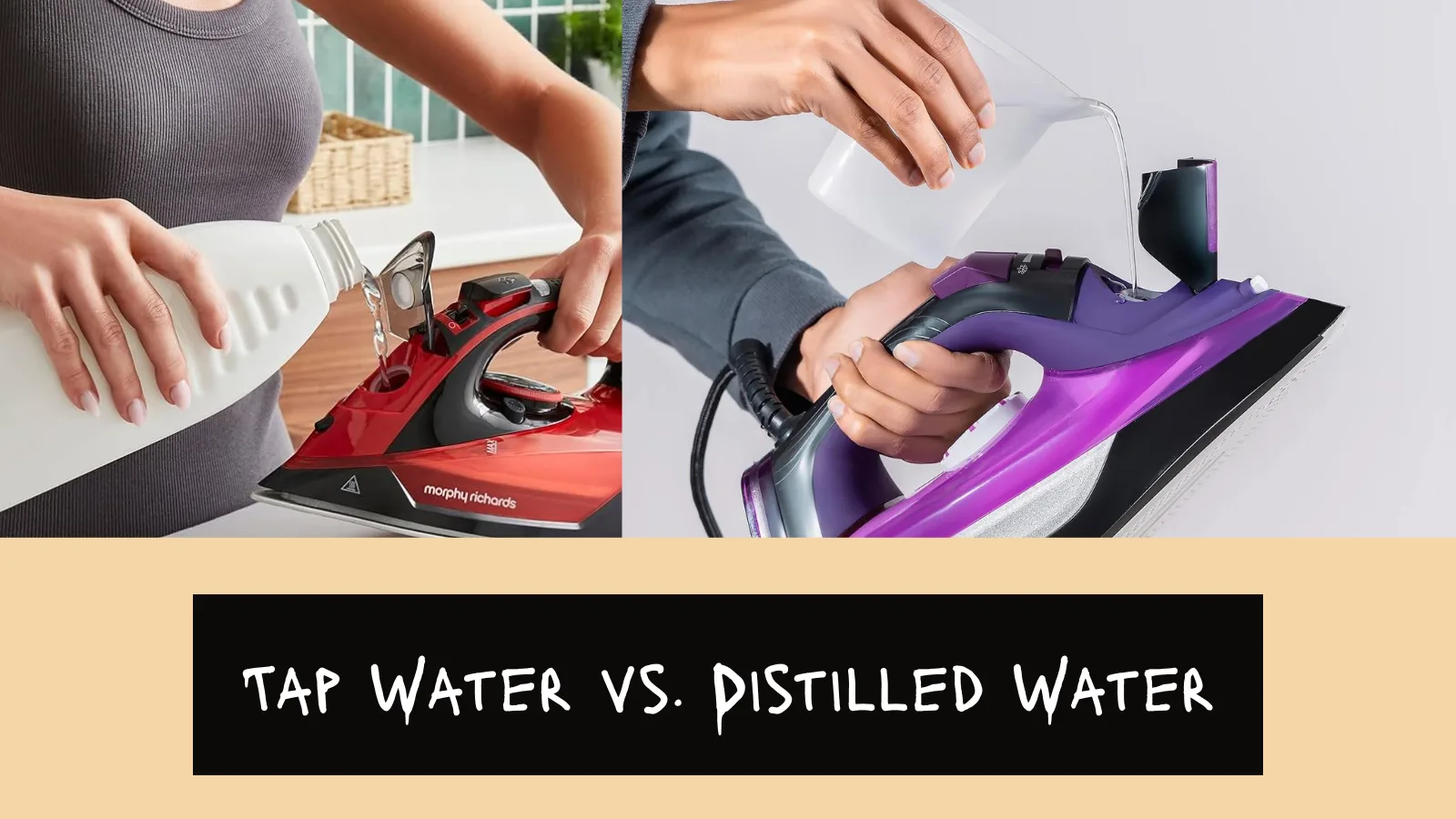
We have all been there. You are halfway through a pile of laundry when your iron suddenly lets out a gasp and spits a brown, murky liquid all over your crisp white dress shirt. It is a moment of pure frustration that usually leads to one question: What exactly am I putting inside this thing?
The debate over tap water versus distilled water is as old as the steam iron itself. If you ask your grandmother, she might insist on distilled water to keep things pure. If you read the modern manual that came with your high-end Rowenta or Philips, you might see a warning against using 100% distilled water.
So, who is right? As it turns out, the answer is not as simple as choosing one over the other. To understand what is best for your iron, we need to look at the chemistry of water and how it interacts with the internal metal and sensors of your appliance.
By the way, if you’re not satisfied with your iron’s performance, click here to view the best steam irons we recommend.
The Problem with Tap Water: The Limescale Factor
Tap water is the most convenient option, but it comes with a hidden cargo of minerals. Depending on where you live, your water contains varying levels of calcium and magnesium. This is what we refer to as water hardness.
When you pour tap water into your iron, the heating element boils it to create steam. However, minerals do not turn into steam. They stay behind in the water tank and the steam chamber. Over time, these minerals crystallize and harden into a substance called calcium carbonate, or limescale.
How limescale affects your iron:
- Clogged Vents: The tiny holes on your soleplate become blocked, leading to uneven steam distribution and “spitting.”
- Reduced Heat Efficiency: Limescale acts as an insulator. When it coats the heating element, the iron has to work harder to reach the same temperature. This can eventually lead to the motor burning out.
- Internal Corrosion: Over time, the buildup can trap moisture against metal parts, causing them to degrade from the inside out.
The Problem with Distilled Water: The Hungry Water Effect
If minerals are the enemy, then distilled water (which has zero minerals) should be the hero. Surprisingly, this is not always the case. Using 100% distilled water can actually be just as damaging to a modern steam iron as hard tap water, but for different reasons.
The Acidity Issue
Distilled water is often slightly acidic because it absorbs carbon dioxide from the air more readily than mineral-rich water. This makes it aggressive or “hungry.” Because it lacks minerals, it tries to pull them from its environment. In this case, it can actually leach minerals directly from the metal alloys inside your iron’s steam chamber, leading to premature pitting and rusting.
The Boiling Point and Spitting
Distilled water can be superheated. Without the microscopic mineral impurities that help bubbles form (nucleation points), the water can stay liquid past its boiling point and then suddenly turn into steam all at once. This results in the iron leaking hot water instead of providing a steady, gentle mist.
Sensor Confusion
Many modern, high-tech irons use electronic sensors to detect water levels. These sensors often rely on the electrical conductivity of the water to work. Since distilled water is a poor conductor of electricity, the iron might think it is empty even when the tank is full, causing the auto-shutoff to trigger or the pump to run dry.
What the Major Manufacturers Say
To get a clear picture of the best practice, it helps to look at the official guidelines from the brands that build these machines. Manufacturers have spent years testing their boilers to see which water type leads to the fewest warranty claims.
Rowenta and Tefal: These brands often recommend a 50/50 mix of tap water and distilled water. They explicitly warn against 100% distilled water because it can cause the iron to drip and spit.
Philips: Most Philips models are designed to be used with tap water. They suggest that if you live in an area with very hard water, you should mix your tap water with an equal part of distilled water to extend the life of the appliance.
Black+Decker: They generally suggest tap water but place a heavy emphasis on using the built-in “Auto-Clean” function regularly to flush out any mineral deposits.
The Golden Rule: The 50/50 Mix
For the vast majority of households, the secret to a long-lasting iron is a compromise. Unless your manufacturer states otherwise in the manual, a 50/50 mix of tap water and distilled water is the ideal solution.
By mixing the two, you dilute the mineral content of your tap water, which significantly slows down the rate of limescale buildup. At the same time, you provide enough mineral content to keep the water pH stable and ensure that the internal sensors function correctly.
Important Note on Water Softeners: If you have a home water softener system, you should actually avoid using that softened water in your iron. Water softeners often replace calcium with salt (sodium). Salt is highly corrosive to the internal components of a steam iron and can leave white, powdery streaks on your clothes that are very difficult to remove.
How to Test Your Water at Home
You do not need a chemistry degree to figure out what your iron needs. You can determine your strategy based on a few simple observations around your house:
- Check your kettle: If your electric kettle has a thick layer of white crust at the bottom, you have hard water. You should definitely use the 50/50 mix.
- Look at your faucets: Is there a chalky residue around the mouth of your kitchen sink? That is a clear sign of high mineral content.
- Local Water Reports: Most city utilities provide an annual water quality report online. Look for the “Hardness” section. If it is above 120 mg/L, you are in the hard water zone.
Maintenance Habits That Save Your Iron
Choosing the right water is only half the battle. To truly maximize the lifespan of your iron, you should adopt a few simple habits that prevent water from causing trouble in the first place.
Empty the Tank After Every Session
Never leave water sitting in the tank between ironing sessions. Even a 50/50 mix will eventually settle, and as the water evaporates slowly, the mineral concentration increases. By emptying the tank while the iron is still warm, the residual heat will dry out the internal chamber, preventing mold and stagnant mineral deposits.
Use the Self-Clean Function Regularly
Most modern irons have a “Calc-Clean” or “Self-Clean” button. Use this at least once a month. It works by sending a sudden burst of water through the heating element to shock the limescale loose and flush it out of the soleplate.
Clean the Soleplate
If you notice the iron is dragging, it might be due to a buildup of burnt starch or synthetic fibers on the bottom. A clean soleplate ensures that the steam can escape freely. You can use a dedicated iron cleaning paste or a damp cloth with a tiny bit of mild dish soap. Avoid abrasive scrubbers that can scratch the coating.
The Final Verdict
So, tap or distilled?
If you live in an area with very soft water, plain tap water is perfectly fine. However, for most of the population, the 50/50 mix is the winner. It protects the metal from the “aggression” of distilled water while shielding the vents from the “clogging” of hard tap water.
By taking these small steps, you are not just saving your clothes from spots; you are ensuring that your iron remains a reliable tool for many years rather than a disposable appliance that ends up in a landfill.